
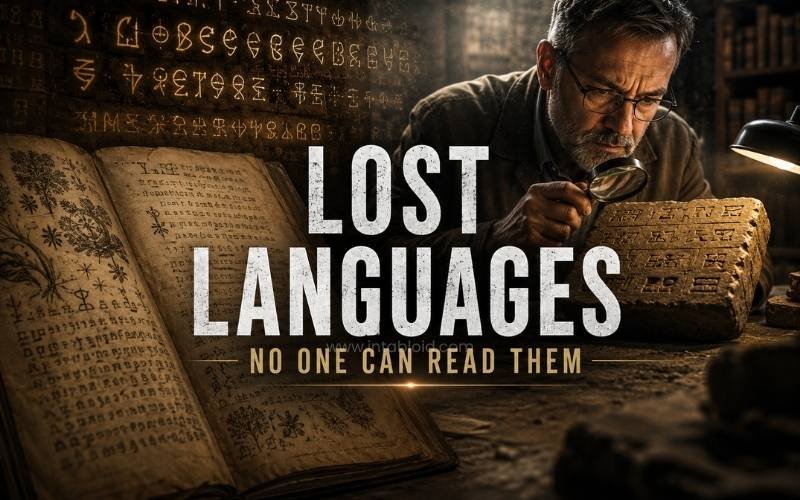

Lost Languages are among the greatest mysteries of human history. Across the world, archaeologists have discovered ancient texts, inscriptions, and symbols that nobody has been able to fully understand.
The words are right in front of us.
The symbols are clearly visible.
Yet their meaning remains unknown.
For centuries, researchers have tried to unlock these forgotten languages, hoping to reveal secrets hidden for thousands of years.
What Are Lost Languages?
Lost Languages are writing systems or languages that can no longer be fully understood because the knowledge needed to read them disappeared.
In some cases, entire civilizations vanished.
In others, their language evolved into something completely different.
Without a translation guide, historians are left with symbols that remain frustratingly mysterious.
Why Are Some Languages Impossible to Read?
Most ancient languages were deciphered because researchers found clues.
A bilingual inscription, a translation, or surviving records often helped unlock their meaning.
But some writing systems have no such key.
Without a known reference point, understanding the text becomes extremely difficult.
That is why certain Lost Languages remain undeciphered even today.
The Mystery of the Voynich Manuscript
One of the most famous examples is the Voynich Manuscript.
This mysterious book contains strange illustrations and an unknown writing system.
For more than a century, linguists, cryptographers, and historians have attempted to decode it.
Despite countless theories, nobody knows exactly what the text says.
Some believe it contains hidden knowledge.
Others suspect it may be an elaborate hoax.
The mystery remains unsolved.
The Indus Script
The Indus Valley Civilization flourished thousands of years ago in South Asia.
Archaeologists have discovered numerous seals covered in symbols known as the Indus Script.
The problem is that the inscriptions are extremely short.
Without longer texts or a bilingual translation, researchers have struggled to determine whether the symbols represent a language, a code, or something else entirely.
Today, the script remains undeciphered.
Rongorongo of Easter Island
Rongorongo is a mysterious writing system discovered on Easter Island.
The symbols appear on wooden tablets and contain complex patterns.
If fully deciphered, Rongorongo could provide valuable information about the island’s history and culture.
Unfortunately, no one has successfully translated the script.
It remains one of the world’s most intriguing linguistic puzzles.
Linear A
Before the rise of ancient Greece, the Minoan civilization thrived on the island of Crete.
They used a writing system known as Linear A.
Although scholars can read many of the symbols phonetically, the underlying language remains unknown.
As a result, the texts still cannot be fully understood.
What Secrets Could These Languages Contain?
The greatest fascination surrounding Lost Languages is the possibility that they contain forgotten knowledge.
They could reveal:
- Historical events
- Religious beliefs
- Scientific observations
- Trade networks
- Daily life details
Entire chapters of human history may remain locked within these undeciphered texts.
How Do Experts Try to Decode Them?
Researchers use a variety of methods.
These include:
- Linguistic analysis
- Pattern recognition
- Statistical modeling
- Archaeological evidence
- Artificial intelligence tools
Modern technology has improved the chances of success, but many mysteries remain unsolved.
Will We Ever Read Them?
Nobody knows.
A single discovery could change everything.
The discovery of a bilingual inscription, similar to the Rosetta Stone, might provide the key researchers have been searching for.
Until then, these languages remain silent witnesses to lost civilizations.
FAQs
What are Lost Languages?
Lost Languages are languages or writing systems that can no longer be fully understood.
What is the most famous undeciphered language?
The Voynich Manuscript and the Indus Script are among the most famous examples.
Why can’t experts translate them?
Many lack translation keys, bilingual texts, or enough surviving material for comparison.
Is the Voynich Manuscript real?
Yes. The manuscript exists, but its meaning remains unknown.
Could AI decode Lost Languages?
Artificial intelligence may help researchers identify patterns, but no major undeciphered script has been fully translated yet.
The Bottom Line
Lost Languages continue to challenge historians, linguists, and archaeologists around the world. From the Voynich Manuscript to the Indus Script and Rongorongo, these mysterious writing systems may hold forgotten stories, knowledge, and history that humanity has yet to uncover.