
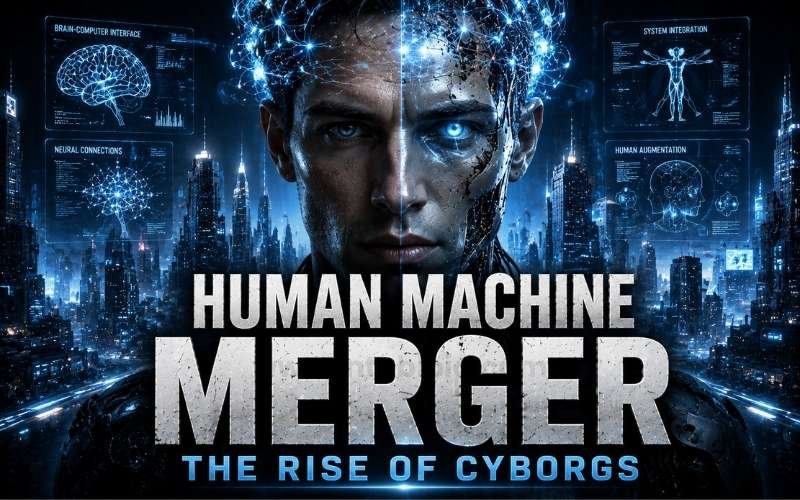

Human Machine Merger is no longer just a science fiction concept. Advances in artificial intelligence, robotics, neural implants, and brain-computer interfaces have raised a question that once seemed impossible:
What happens when humans begin merging with machines?
For thousands of years, technology has existed outside the human body.
We use tools.
We carry smartphones.
We wear computers on our wrists.
But future technology may become part of us.
If that happens, the boundary between human and machine could begin to disappear.
What Is a Human Machine Merger?
Human Machine Merger refers to the integration of technology directly into the human body or brain.
Instead of using machines externally, people would interact with technology as a natural extension of themselves.
Examples already exist today.
These include:
- Artificial limbs
- Cochlear implants
- Retinal implants
- Brain-computer interfaces
- Neural implants
Although current systems remain limited, future versions could become dramatically more powerful.
Are Humans Already Becoming Cyborgs?
In a way, yes.
Many people already rely on implanted medical devices.
Pacemakers help regulate heart rhythms.
Cochlear implants restore aspects of hearing.
Advanced prosthetic limbs can respond to nerve signals.
These technologies demonstrate that human-machine integration is already happening.
The question is how far it might eventually go.
The Role of Brain-Computer Interfaces
One of the most important technologies behind a Human Machine Merger is the brain-computer interface, often called a BCI.
These systems attempt to create direct communication between the brain and computers.
Researchers hope future BCIs could:
- Restore movement
- Improve communication
- Control devices with thoughts
- Assist people with disabilities
Some futurists believe BCIs could eventually allow humans to access information instantly without traditional screens.
Could Humans Become Smarter?
Supporters of human augmentation argue that future technologies could enhance memory, learning, and problem-solving.
Imagine:
- Instant language translation
- Expanded memory capacity
- Direct access to information
- Enhanced sensory abilities
Such possibilities raise exciting opportunities but also significant ethical concerns.
Would We Still Be Human?
This is where the mystery becomes philosophical.
If technology gradually replaces or enhances parts of the human body, at what point does a person stop being fully human?
Most people would agree that a pacemaker does not change someone’s humanity.
But what about an artificial brain implant that enhances intelligence?
Or synthetic eyes capable of seeing beyond normal human limits?
There is no universally accepted answer.
The Risks of Human Machine Integration
A future Human Machine Merger could introduce new challenges.
These may include:
- Privacy concerns
- Cybersecurity threats
- Technological dependence
- Social inequality
- Ethical dilemmas
If technology becomes part of the human body, protecting that technology may become as important as protecting the body itself.
Could Society Become Divided?
Some experts worry that advanced human enhancements may initially be available only to wealthy individuals.
This could create new forms of inequality.
Enhanced humans might possess advantages unavailable to others.
As a result, governments and researchers are already discussing how future regulations might work.
Why Is This a Future Mystery?
No one knows how far human-machine integration will progress.
Technology continues advancing at remarkable speed.
At the same time, fundamental questions about identity, consciousness, and humanity remain unanswered.
Whether future humans become cyborgs, remain largely biological, or develop entirely new forms of existence is still unknown.
FAQs
What is a Human Machine Merger?
It is the integration of technology directly into the human body or brain.
Are humans already merging with machines?
Yes. Technologies such as pacemakers, cochlear implants, and advanced prosthetics are early examples.
What is a brain-computer interface?
A brain-computer interface allows direct communication between the brain and a computer system.
Could humans become cyborgs?
Future technologies may lead to increasingly advanced forms of human-machine integration.
Is Human Machine Merger possible today?
Basic forms already exist, but the advanced concepts discussed by futurists remain largely theoretical.
The Bottom Line
Human Machine Merger represents one of the most fascinating possibilities in humanity’s future. As technology moves closer to the human body and mind, questions about identity, intelligence, and what it means to be human may become more important than ever before. Whether this future becomes reality remains one of the greatest mysteries of the technological age.