
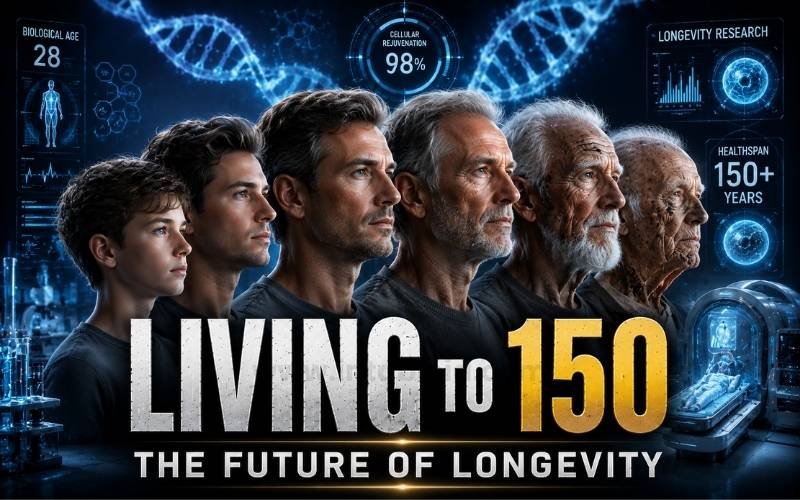

Living to 150 has long been considered impossible. However, advances in longevity science, genetics, artificial intelligence, and regenerative medicine are forcing scientists to rethink what the future of aging might look like.
A hundred years ago, reaching the age of 80 was uncommon.
Today, millions of people routinely live into their eighties and nineties.
As healthcare continues to improve, researchers are beginning to ask a question that once belonged only to science fiction:
Could humans eventually live to 150 years old?
The answer remains one of the greatest mysteries in modern science.
How Long Can Humans Live Today?
The oldest verified person in history was Jeanne Calment of France, who lived to 122 years and 164 days.
Her record has stood for decades.
While medical advances have increased average life expectancy, very few people live beyond the age of 110.
This has led scientists to debate whether humans possess a natural lifespan limit or whether future technology could extend life much further.
Why Do Humans Age?
Aging is a complex biological process.
Over time, damage accumulates within cells and tissues throughout the body.
Researchers believe several factors contribute to aging, including:
- DNA damage
- Cellular wear and tear
- Chronic inflammation
- Protein breakdown
- Declining stem cell function
As these processes continue, the body’s ability to repair itself gradually decreases.
Understanding these mechanisms is essential if Living to 150 is ever going to become reality.
Can Science Slow Down Aging?
Many scientists no longer view aging as an unavoidable process.
Instead, they see it as something that may eventually be slowed, modified, or partially reversed.
Researchers are currently studying:
- Gene therapy
- Stem cell treatments
- Regenerative medicine
- Anti-aging drugs
- Cellular rejuvenation
Experiments in animals have already produced promising results.
The challenge is determining whether similar breakthroughs can safely extend human lifespan.
The Rise of Longevity Science
Longevity science has become one of the fastest-growing areas of medical research.
Scientists are exploring ways to prevent age-related diseases before they occur.
Rather than treating individual illnesses, the goal is to improve the body’s overall ability to remain healthy for longer periods.
If successful, future treatments could significantly increase both lifespan and healthspan.
Could Artificial Intelligence Help Humans Live Longer?
Artificial intelligence is already transforming medical research.
AI systems can analyze enormous amounts of biological data much faster than human researchers.
This allows scientists to identify patterns, discover potential treatments, and accelerate drug development.
Some experts believe AI could play a major role in helping humans achieve dramatically longer lifespans.
What Would Life Be Like at 150?
If Living to 150 became common, society would change dramatically.
Potential impacts might include:
- Longer careers
- Delayed retirement
- Multiple professions during one lifetime
- Extended education
- New family structures
Governments, healthcare systems, and economies would all need to adapt to a population living much longer than previous generations.
The Ethical Challenges
Extreme longevity would create new ethical questions.
For example:
- Who would have access to life-extending treatments?
- Could longer lifespans increase inequality?
- How would retirement systems function?
- Would population growth become a concern?
These issues could become just as important as the scientific challenges themselves.
Is Living to 150 Actually Possible?
At present, nobody knows.
Some researchers believe human lifespan limits can be pushed far beyond current expectations.
Others argue that biological constraints may ultimately prevent such dramatic increases.
The scientific community remains divided.
That uncertainty is precisely what makes Living to 150 one of the most fascinating future mysteries.
Why This Question Matters
Throughout history, humans have searched for ways to extend life.
Ancient civilizations dreamed of immortality.
Modern science seeks longevity through technology and medicine.
Whether future generations will routinely celebrate their 150th birthday remains unknown.
What is certain is that humanity has never been closer to exploring the possibility.
FAQs
What does Living to 150 mean?
It refers to the possibility that future humans could reach 150 years of age through advances in science and medicine.
Has anyone ever lived to 150?
No. The oldest verified human lived to 122 years and 164 days.
Can aging be slowed?
Researchers are studying several methods that may slow aspects of the aging process.
What is longevity science?
Longevity science focuses on understanding aging and developing ways to extend healthy human lifespan.
Could AI help humans live longer?
Many scientists believe AI could accelerate medical discoveries that improve lifespan and healthspan.
The Bottom Line
Living to 150 remains one of the most intriguing possibilities in the future of humanity. Advances in genetics, biotechnology, artificial intelligence, and longevity science continue challenging traditional assumptions about aging. Whether humans will one day routinely reach 150 years of age remains uncertain, but research suggests the boundaries of human lifespan may not be as fixed as once believed.