
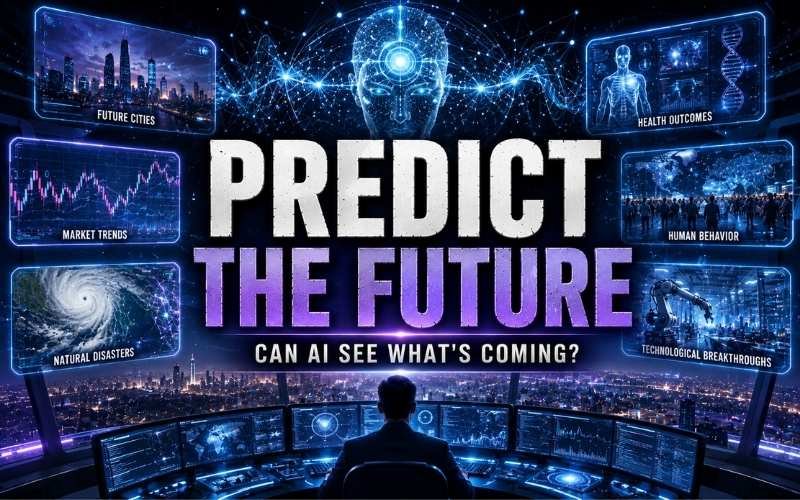

Predict the Future has always been one of humanity’s greatest ambitions. From ancient prophecies and fortune tellers to modern supercomputers, people have spent thousands of years trying to understand what tomorrow might bring.
Today, a new contender has entered the search for the future: artificial intelligence.
AI can analyze enormous amounts of information in seconds.
It can detect patterns humans miss.
It can identify trends hidden within mountains of data.
As these systems become more powerful, many people are beginning to ask a fascinating question:
Can AI actually Predict the Future?
The answer is both impressive and mysterious.
Why Humans Want to Predict the Future
Throughout history, civilizations have tried to forecast future events.
Knowing what happens next offers obvious advantages.
People want to predict:
- Economic changes
- Natural disasters
- Elections
- Market trends
- Health outcomes
- Technological breakthroughs
The ability to accurately forecast future events could transform nearly every aspect of society.
How Does AI Make Predictions?
Artificial intelligence does not see the future in a supernatural sense.
Instead, it studies the past and present.
Machine learning systems analyze massive datasets and identify patterns that may indicate what is likely to happen next.
For example, AI can examine:
- Consumer behavior
- Weather records
- Financial markets
- Medical histories
- Traffic patterns
Using this information, AI generates predictions based on probabilities.
AI Is Already Predicting the Future
In many ways, AI already helps Predict the Future every day.
Examples include:
Weather Forecasting
Modern weather predictions rely heavily on AI and advanced computing systems.
These tools analyze atmospheric conditions to forecast storms, rainfall, and temperature changes.
Online Recommendations
Streaming platforms and online stores use AI to predict what users may want to watch or buy next.
Healthcare
Researchers use predictive AI to identify potential health risks and disease patterns before symptoms appear.
Finance
Investment firms use AI models to forecast market movements and economic trends.
While these predictions are not always correct, they often outperform traditional methods.
Can AI Predict Human Behavior?
One of the most controversial areas of predictive technology involves human behavior.
By analyzing enormous amounts of data, AI systems can often estimate:
- Purchasing habits
- Voting tendencies
- Consumer preferences
- Online behavior
Some experts believe predictive systems will become increasingly accurate as more data becomes available.
Others argue that human behavior is too complex and unpredictable to forecast perfectly.
The Limits of Prediction
Even the most advanced AI faces significant limitations.
The future is influenced by countless variables.
Unexpected events can completely change outcomes.
Examples include:
- Natural disasters
- Political upheaval
- Scientific breakthroughs
- Economic shocks
- Human decisions
A single unforeseen event can invalidate even the most sophisticated forecast.
This is why perfect prediction remains impossible.
Could AI Predict Major World Events?
Some futurists believe advanced AI may eventually forecast large-scale events with remarkable accuracy.
Future systems could potentially identify warning signs for:
- Economic recessions
- Disease outbreaks
- Resource shortages
- Infrastructure failures
If successful, these predictions could help governments and organizations prepare more effectively.
However, the complexity of global systems makes certainty unlikely.
What Happens If AI Becomes Extremely Accurate?
Imagine an AI capable of predicting major decisions before they happen.
Such a system could influence:
- Politics
- Business
- Law enforcement
- Healthcare
- National security
This possibility raises important ethical questions.
Who controls the predictions?
Who has access to them?
Could predictive technology be abused?
These concerns are becoming increasingly relevant as AI capabilities grow.
Could AI Ever Predict Everything?
Most scientists believe the answer is no.
The universe contains too many variables.
Quantum mechanics itself introduces elements of uncertainty.
Human free will, random events, and complex systems make complete prediction extremely difficult.
Even so, AI may continue becoming far better at forecasting specific outcomes.
Why Is Predict the Future a Mystery?
Artificial intelligence has already demonstrated remarkable predictive abilities.
Yet nobody knows how accurate future systems might become.
Will AI merely improve forecasting?
Or could it fundamentally change humanity’s relationship with uncertainty?
The answer remains unknown.
That uncertainty makes the ability to Predict the Future one of the most fascinating mysteries of the technological age.
FAQs
Can AI Predict the Future?
AI cannot see the future directly, but it can analyze data and forecast likely outcomes.
How does predictive AI work?
Predictive AI uses machine learning algorithms to identify patterns and estimate future events.
Is AI already used for forecasting?
Yes. AI is widely used in weather forecasting, healthcare, finance, and consumer behavior analysis.
Can AI predict human behavior?
To some extent. AI can identify trends and probabilities but cannot predict every individual decision.
Will AI ever predict everything?
Most experts believe perfect prediction is impossible due to uncertainty and complex variables.
The Bottom Line
Predict the Future has been a human goal for thousands of years, and artificial intelligence may be the most powerful forecasting tool ever created. While AI cannot provide absolute certainty, its ability to identify patterns and predict outcomes continues improving rapidly. Whether future AI systems will revolutionize forecasting or encounter limits that cannot be overcome remains one of the most intriguing mysteries of our time.