
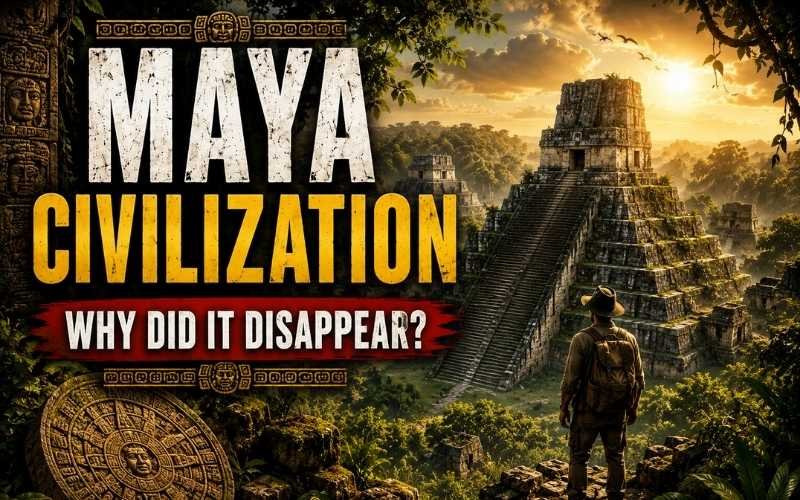

Maya Civilization was one of the most advanced societies in the ancient world. Long before modern technology existed, the Maya built enormous cities, created complex calendars, studied astronomy, and developed one of the most sophisticated writing systems in the Americas.
For centuries, their civilization flourished across parts of modern-day Mexico, Guatemala, Belize, Honduras, and El Salvador.
Then something strange happened.
Many of their great cities were abandoned.
Monuments stopped being built.
Populations declined.
To later observers, it almost looked as if the Maya Civilization had disappeared overnight.
But what really happened?
Who Were the Maya?
The Maya Civilization emerged thousands of years ago and eventually became one of the dominant cultures in Mesoamerica.
The Maya built impressive urban centers surrounded by pyramids, temples, palaces, and public plazas.
Cities such as Tikal, Palenque, and Copán became major centers of power.
Unlike many ancient empires, the Maya were not ruled by a single king.
Instead, numerous city-states competed, traded, and occasionally fought with one another.
Masters of Science and Astronomy
One reason the Maya Civilization fascinates historians is its remarkable scientific knowledge.
The Maya carefully observed the night sky.
They tracked the movements of planets and stars with surprising accuracy.
Their calendars were among the most sophisticated systems created in the ancient world.
They also developed a writing system capable of recording historical events, rulers, and religious beliefs.
These achievements demonstrate that the Maya were far more advanced than many people realize.
What Happened to the Maya Cities?
Between roughly 750 and 900 AD, many major Maya cities began to decline.
Large populations left urban centers.
Construction projects slowed.
Some cities were eventually abandoned altogether.
For centuries, this collapse puzzled historians.
Early explorers who discovered ruins deep in the jungle struggled to understand why such impressive cities had been deserted.
Why Did the Maya Civilization Collapse?
Researchers now believe there was no single cause.
Instead, several factors likely combined to create a crisis.
Drought
Evidence suggests that severe droughts affected parts of the Maya world.
Water shortages would have made farming much more difficult.
Warfare
Competition between city-states intensified during the civilization’s later years.
Frequent conflict weakened political stability.
Population Pressure
Growing populations placed increasing demands on resources.
Forests were cleared and agricultural systems became strained.
Political Problems
Power struggles among rulers may have contributed to instability.
Together, these challenges created conditions that many cities could not overcome.
Did the Maya Civilization Really Disappear?
Not exactly.
This is one of the biggest misconceptions about Maya history.
The great cities declined, but the Maya people survived.
Millions of Maya descendants still live in Central America today.
They continue to maintain traditions, languages, and cultural practices that connect them to their ancestors.
In other words, the civilization changed—but it did not completely vanish.
Rediscovering the Maya World
When archaeologists began studying Maya ruins in detail, they uncovered one of the most remarkable civilizations in human history.
Modern technology has revealed hidden roads, buildings, and entire settlements beneath dense jungle vegetation.
Researchers continue making new discoveries every year.
In many ways, we are still learning about the true scale of the Maya Civilization.
Why Does the Maya Civilization Matter Today?
The Maya Civilization demonstrates how complex and sophisticated ancient societies could become.
Their achievements in astronomy, mathematics, architecture, and writing continue to impress researchers.
Their story also serves as a reminder that environmental pressures, political instability, and resource challenges can affect even the most successful societies.
FAQs
What was the Maya Civilization?
The Maya Civilization was an advanced ancient society that developed across parts of Central America and southern Mexico.
Why did the Maya Civilization collapse?
Most historians believe drought, warfare, population pressure, and political instability all played important roles.
Did the Maya people disappear?
No. Millions of Maya descendants still live in Central America today.
Where were the Maya located?
The Maya lived across regions that are now Mexico, Guatemala, Belize, Honduras, and El Salvador.
What are the Maya famous for?
The Maya are known for their cities, pyramids, astronomy, mathematics, calendars, and writing system.
The Bottom Line
Maya Civilization remains one of history’s greatest achievements. Although many of its famous cities declined centuries ago, the Maya people endured. Their legacy survives through archaeological discoveries, living communities, and a cultural heritage that continues to shape the region today.