
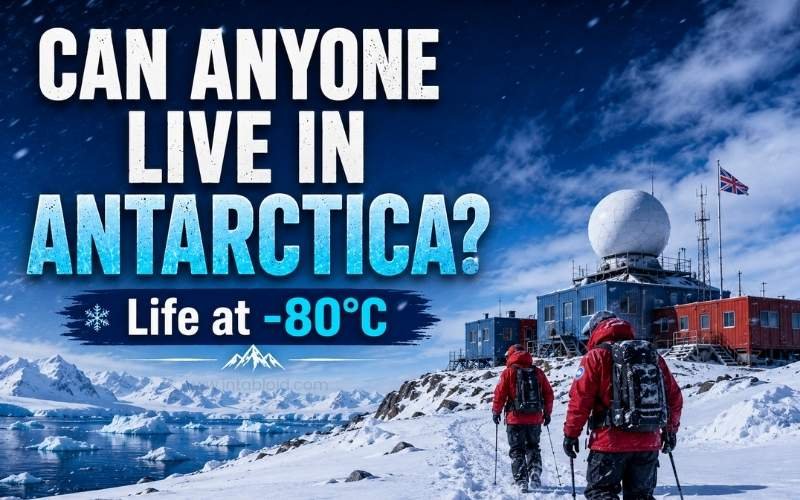

Can anyone live in Antarctica?
The answer is yes—but probably not in the way you’re imagining.
Despite being the coldest continent on Earth, Antarctica is not completely empty. Every year, thousands of people live there for weeks or even months at a time. Scientists, engineers, pilots, doctors, and support staff work on the frozen continent throughout the year.
However, there is one important difference between Antarctica and every other continent on Earth: nobody lives there permanently.
So why can people live in Antarctica temporarily, but not permanently? And what is daily life actually like at the bottom of the world?
Let’s find out.
The Short Answer
Yes, people can live in Antarctica.
However, there are no permanent residents. Most people living in Antarctica are scientists and support workers staying at research stations for a limited period of time.
When their assignments end, they return home.
How Many People Live in Antarctica?
The population of Antarctica changes throughout the year.
During the summer months, when conditions are less extreme, around 4,000 to 5,000 people may be living on the continent.
During the winter, that number drops dramatically.
Only about 1,000 people remain as temperatures become colder and many research projects pause until the next season.
This makes Antarctica one of the least populated places on Earth.
Who Lives in Antarctica?
Most people living in Antarctica work at research stations operated by different countries.
These stations are designed to support scientific studies in fields such as:
- Climate change
- Marine biology
- Astronomy
- Glaciology
- Environmental science
People living there include:
- Scientists
- Engineers
- Doctors
- Pilots
- Mechanics
- Electricians
- Chefs
In many ways, a research station functions like a tiny isolated town.
Also Read: Why Isn’t Antarctica a Country? The Surprising Reason Explained
Why Doesn’t Anyone Live in Antarctica Permanently?
There are several reasons why Antarctica has no permanent population.
Extreme Cold
Antarctica is the coldest place on Earth.
In some areas, winter temperatures can fall below -80°C (-112°F).
Even during summer, many regions remain below freezing.
Surviving these conditions requires specialized equipment, insulated buildings, and constant supplies.
Isolation
Antarctica is one of the most remote places on the planet.
Many research stations can only be reached by aircraft or ice-strengthened ships.
If an emergency occurs during winter, help may be days away.
Lack of Infrastructure
Unlike normal countries, Antarctica has:
- No cities
- No permanent towns
- No shopping centers
- No universities
- No large hospitals
Building and maintaining infrastructure in such extreme conditions would be incredibly expensive.
What Is Daily Life Like in Antarctica?
Life in Antarctica is very different from life almost anywhere else.
Most people live inside research stations where temperatures are carefully controlled.
A typical day may include:
- Conducting scientific experiments
- Collecting ice samples
- Monitoring wildlife
- Maintaining equipment
- Studying weather patterns
Outside, workers often face freezing winds, heavy snow, and long periods of darkness during winter.
Despite the challenges, many researchers describe Antarctica as one of the most fascinating places they have ever visited.
Have Any Babies Been Born in Antarctica?
Surprisingly, yes.
Several babies have been born in Antarctica over the years.
Most births occurred at settlements operated by countries with territorial claims in the region.
However, these births do not mean Antarctica has a permanent population.
The families involved eventually returned to their home countries.
Can Ordinary People Move to Antarctica?
Not really.
There is currently no immigration system for Antarctica.
You cannot simply buy a house and move there permanently.
Most people who spend time on the continent do so through:
- Scientific programs
- Government research projects
- Specialized jobs
- Temporary expeditions
For the average person, living in Antarctica full-time is not an option.
Is Antarctica a Country?
No.
Antarctica is a continent, not a country.
It has no national government, no president, and no permanent citizens.
Instead, the continent is governed through the Antarctic Treaty System, an international agreement focused on peaceful scientific cooperation.
Who Owns Antarctica?
No single country owns Antarctica.
Although several nations have territorial claims, the continent is managed under international agreements that prevent countries from taking full control.
This unique arrangement makes Antarctica unlike anywhere else on Earth.
FAQs
Can anyone live in Antarctica permanently?
No. Antarctica has no permanent residents. People only live there temporarily for work and research.
How many people live in Antarctica?
The population usually ranges from about 1,000 people in winter to around 5,000 during summer.
Why is Antarctica so hard to live in?
Extreme cold, isolation, strong winds, and limited infrastructure make permanent settlement very difficult.
Can tourists visit Antarctica?
Yes. Tourists can visit Antarctica through regulated expedition cruises and guided tours.
Has anyone been born in Antarctica?
Yes. Several babies have been born in Antarctica, although the continent still has no permanent population.
The Bottom Line
Can anyone live in Antarctica?
Yes, but only temporarily.
Thousands of people work and live on the frozen continent every year, helping scientists learn more about our planet. Yet Antarctica remains the only continent without a permanent population.
Its extreme climate, isolation, and unique international status make it one of the most extraordinary places on Earth—and one of the few places where people can visit, work, and explore, but never truly settle.
Why Isn’t Antarctica a Country? The Surprising Reason Explained