
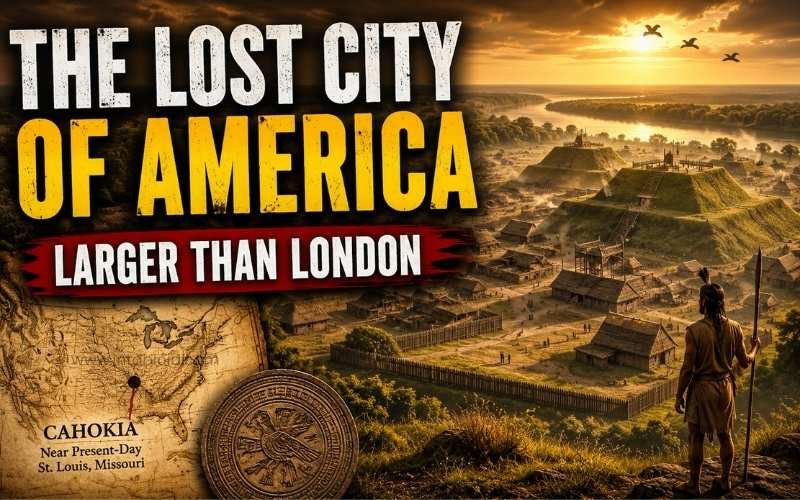

Cahokia was once the largest city in North America. Long before European explorers arrived on the continent, thousands of people lived in this remarkable settlement near present-day St. Louis. Today, most people have never heard of Cahokia, yet historians consider it one of the most important ancient cities ever built in North America.
At its peak, Cahokia was larger than many European cities of the same era.
Then something happened.
The population declined, the city was abandoned, and one of the continent’s greatest urban centers slowly faded into history.
So what happened to Cahokia?
What Was Cahokia?
Cahokia was a massive pre-Columbian city built by the Mississippian people.
The city flourished between approximately 1050 and 1350 AD.
Located near the Mississippi River, Cahokia became a political, economic, and cultural center for a vast region.
Archaeologists estimate that between 10,000 and 20,000 people may have lived there during its peak years.
That made Cahokia larger than many cities in medieval Europe.
For centuries, it was the most influential settlement north of Mexico.
The City of Giant Earth Mounds
One of the most fascinating features of Cahokia was its enormous earth mounds.
Instead of building pyramids from stone, the city’s inhabitants moved millions of baskets of soil to create massive structures.
The largest of these is known as Monks Mound.
Even today, it remains the largest prehistoric earthwork in North America.
The mound rises more than 30 meters above the surrounding landscape and covers a huge area.
From its summit, leaders could oversee much of the city.
These construction projects demonstrate how organized and powerful Cahokia had become.
Why Was Cahokia So Important?
Cahokia’s location helped it thrive.
The nearby Mississippi River created trade opportunities with distant communities.
Merchants exchanged goods across large parts of North America.
Items discovered at archaeological sites suggest that Cahokia maintained connections with regions hundreds of kilometers away.
The city also became a religious and ceremonial center.
Large public spaces hosted gatherings, ceremonies, and important events.
For generations, Cahokia stood at the center of a thriving civilization.
Why Did Cahokia Disappear?
This is the question that continues to fascinate historians.
No single answer has been proven.
Instead, researchers believe several factors likely contributed to the city’s decline.
Environmental Problems
As the population grew, forests were cleared to provide wood and farmland.
Over time, environmental damage may have made it harder to support a large population.
Flooding
The Mississippi River was both a blessing and a danger.
Major floods may have damaged farmland and disrupted daily life.
Political Instability
Large cities often face internal tensions.
Some historians believe social or political conflicts weakened the city.
Resource Shortages
A growing population required increasing amounts of food, wood, and other resources.
Eventually, the region may have struggled to meet those demands.
By the 1300s, Cahokia was already declining.
Within a few generations, much of the city had been abandoned.
What Happened After the City Was Abandoned?
After people left, nature slowly reclaimed the area.
Forests grew.
Buildings disappeared.
Only the giant earth mounds remained.
When European settlers later arrived in the region, they found these mysterious structures but had little understanding of who built them.
For many years, myths and misconceptions surrounded the site.
Modern archaeology eventually revealed the truth.
The mounds were the remains of an advanced and sophisticated civilization.
What Remains of Cahokia Today?
Today, Cahokia is one of the most important archaeological sites in the United States.
Visitors can still explore the surviving earth mounds and learn about the city’s history.
Although much of the original city has vanished, the remaining structures offer a glimpse into a civilization that once dominated the region.
The site serves as a reminder that complex urban societies existed in North America long before European colonization.
Why Does Cahokia Still Matter?
Cahokia challenges many assumptions about ancient North America.
For decades, people underestimated the size and complexity of indigenous civilizations on the continent.
The discovery and study of Cahokia revealed a different story.
It showed that large cities, extensive trade networks, and sophisticated political systems existed centuries before Europeans arrived.
That is why Cahokia remains one of the most significant archaeological discoveries in American history.
FAQs
What was Cahokia?
Cahokia was the largest pre-Columbian city in North America and the center of a powerful Mississippian civilization.
Where was Cahokia located?
Cahokia was located near present-day St. Louis in the United States.
Why did Cahokia disappear?
Historians believe environmental problems, flooding, resource shortages, and political instability all contributed to its decline.
How large was Cahokia?
At its peak, Cahokia may have had a population between 10,000 and 20,000 people, making it one of the largest cities in North America.
Can you visit Cahokia today?
Yes. Visitors can explore the preserved archaeological site and its famous earth mounds.
The Bottom Line
Cahokia was once one of the greatest cities in North America. For centuries it served as a center of trade, culture, and political power. Although the city eventually disappeared, its massive earth mounds and fascinating history continue to reveal the story of a civilization that helped shape the continent long before modern nations existed.