
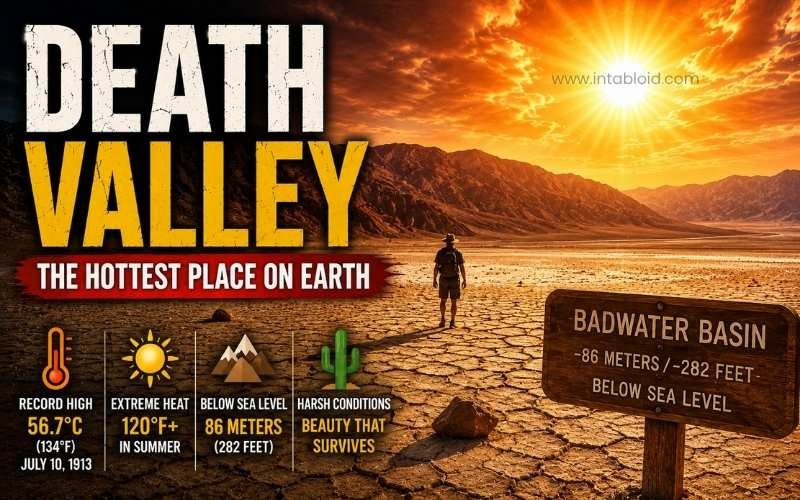

Death Valley is one of the most extreme environments on the planet. Located in California, this desert region has recorded some of the highest air temperatures ever measured on Earth.
During summer, the heat can become so intense that the ground itself feels almost untouchable.
Despite its harsh conditions, Death Valley attracts thousands of visitors every year.
Its dramatic landscapes, colorful rock formations, and record-breaking temperatures make it one of the most fascinating places in the world.
Where Is Death Valley?
Death Valley is located in eastern California near the border with Nevada.
It forms part of Death Valley National Park, one of the largest national parks in the United States.
The region is surrounded by mountains, which play a major role in creating its extreme climate.
Its remote location and desert environment contribute to the intense heat experienced throughout the year.
Why Is Death Valley So Hot?
Several factors combine to make Death Valley exceptionally hot.
Low Elevation
Badwater Basin, one of the valley’s most famous locations, sits about 86 meters below sea level.
Hot air becomes trapped within the basin, causing temperatures to rise.
Surrounding Mountains
Mountain ranges surrounding the valley prevent cooler air from easily entering the region.
Heat remains trapped for long periods.
Clear Skies
The desert experiences abundant sunshine throughout the year.
With very little cloud cover, sunlight continuously heats the landscape.
Dry Air
Low humidity allows the ground to heat rapidly during the day.
Together, these conditions create one of the hottest climates on Earth.
How Hot Does Death Valley Get?
Death Valley holds the record for one of the highest air temperatures ever recorded.
In July 1913, Furnace Creek recorded an astonishing temperature of 56.7°C (134°F).
Even today, summer temperatures frequently exceed 49°C (120°F).
Ground temperatures can become even higher.
Walking across exposed surfaces during peak summer conditions can be dangerous.
Can Anything Live There?
Surprisingly, yes.
Despite its harsh environment, Death Valley supports a variety of life.
Animals found in the region include:
- Coyotes
- Desert foxes
- Lizards
- Snakes
- Bighorn sheep
Plants have also adapted to survive extreme heat and limited rainfall.
These species demonstrate nature’s remarkable ability to thrive in difficult conditions.
Why Is It Called Death Valley?
The name dates back to the mid-1800s.
According to historical accounts, pioneers traveling through the region faced severe hardships while attempting to cross the desert.
Although most survived, the difficult journey left a lasting impression.
The area eventually became known as Death Valley.
The dramatic name has remained ever since.
Is Death Valley Worth Visiting?
Absolutely.
Visitors come from around the world to experience its unique landscapes.
Popular attractions include:
- Badwater Basin
- Zabriskie Point
- Mesquite Flat Sand Dunes
- Artist’s Palette
The scenery often appears more like another planet than a typical desert.
Photographers especially love the region during sunrise and sunset.
Why Does Death Valley Matter?
Death Valley provides scientists with valuable insights into extreme environments.
Researchers study its climate, geology, and ecosystems to better understand how life adapts to challenging conditions.
As global temperatures rise, the region also serves as an important location for studying heat-related environmental changes.
FAQs
Where is Death Valley located?
Death Valley is located in eastern California, United States.
Why is Death Valley so hot?
Its low elevation, surrounding mountains, dry air, and intense sunshine create extreme temperatures.
What is the highest temperature recorded in Death Valley?
One of the highest recorded air temperatures was 56.7°C (134°F) at Furnace Creek.
Can people visit Death Valley?
Yes. It is a popular tourist destination within Death Valley National Park.
Does anything live in Death Valley?
Yes. Many plants and animals have adapted to survive the harsh desert environment.
The Bottom Line
Death Valley is one of the most extraordinary places on Earth. Its record-breaking temperatures, unique desert landscapes, and remarkable wildlife make it a destination unlike any other. While the heat can be extreme, it also reveals the incredible resilience of nature in one of the planet’s toughest environments.