
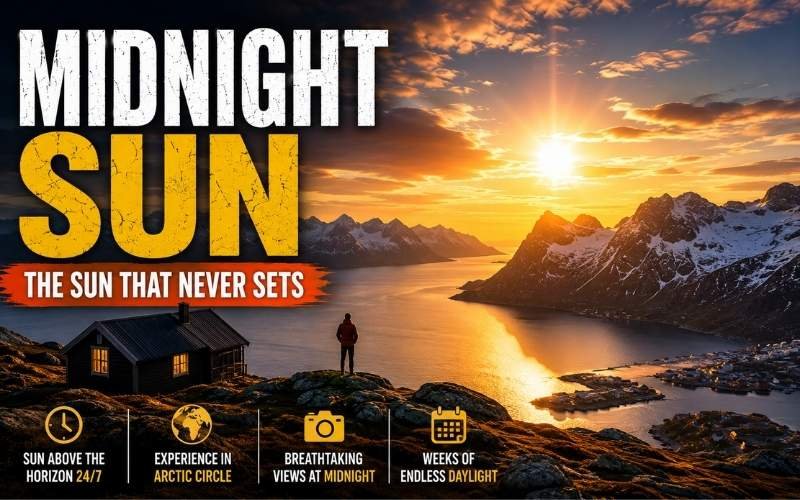

Midnight Sun is one of the most fascinating natural phenomena on Earth. In certain parts of the world, the sun remains visible even at midnight, creating days that seem to last forever.
Imagine looking outside at 12:00 AM and seeing bright daylight instead of darkness.
For millions of people living near the Arctic and Antarctic Circles, this is a real experience.
The phenomenon is known as the Midnight Sun, and it continues to amaze travelers, scientists, and photographers from around the world.
What Is the Midnight Sun?
The Midnight Sun occurs when the sun remains above the horizon for 24 hours or longer.
Normally, Earth rotates in a way that creates day and night.
However, near the poles, Earth’s tilt changes how sunlight reaches the surface during certain times of the year.
As a result, the sun never fully sets.
Even at midnight, daylight remains visible.
Why Does the Midnight Sun Happen?
The Midnight Sun is caused by Earth’s axial tilt.
Earth is tilted approximately 23.5 degrees as it orbits the Sun.
During summer in the Northern Hemisphere, the North Pole tilts toward the Sun.
This allows regions near the Arctic Circle to receive continuous sunlight.
The same thing happens near the Antarctic Circle during the Southern Hemisphere’s summer.
The closer you are to the poles, the longer the period of continuous daylight.
Where Can You See the Midnight Sun?
Several locations are famous for experiencing the Midnight Sun.
Norway
Often called the “Land of the Midnight Sun,” Norway attracts thousands of visitors every year.
Sweden
Northern Sweden experiences long summer days and stunning midnight sunlight.
Finland
Many areas above the Arctic Circle enjoy weeks of continuous daylight.
Iceland
Parts of Iceland experience extremely long summer days, although not all areas qualify for a true Midnight Sun.
Alaska
Northern Alaska experiences extended periods when the sun never sets.
How Long Does the Midnight Sun Last?
The duration depends on location.
Near the Arctic Circle, the phenomenon may last only a few days.
Closer to the North Pole, it can continue for months.
At the North Pole itself, the sun remains above the horizon for approximately six months.
This creates one of the most unusual day-night cycles on Earth.
Does the Midnight Sun Affect People?
Yes.
Continuous daylight can influence sleep patterns.
Many visitors find it difficult to adjust because their bodies expect darkness at night.
Residents often use blackout curtains to create artificial darkness indoors.
Despite this challenge, many people enjoy the extra daylight for outdoor activities and tourism.
Why Is the Midnight Sun So Popular?
The Midnight Sun creates incredible landscapes and photography opportunities.
Mountains, oceans, forests, and glaciers remain illuminated throughout the night.
The golden light of the late evening can last for hours.
This creates scenes that look almost unreal.
For many travelers, witnessing the Midnight Sun becomes a once-in-a-lifetime experience.
Midnight Sun vs Polar Night
The Midnight Sun has an opposite phenomenon known as Polar Night.
During winter, some polar regions experience extended darkness because the sun never rises above the horizon.
Together, these two events demonstrate how unusual life can be near Earth’s poles.
FAQs
What is the Midnight Sun?
The Midnight Sun is a phenomenon where the sun remains visible at midnight.
Why does the Midnight Sun occur?
It occurs because of Earth’s 23.5-degree tilt and its position relative to the Sun.
Where can you see the Midnight Sun?
Norway, Sweden, Finland, Alaska, and parts of the Arctic are popular locations.
Does the Midnight Sun happen every day?
No. It occurs during summer months in regions near the Arctic and Antarctic Circles.
Can people sleep during the Midnight Sun?
Yes, although many use blackout curtains because continuous daylight can affect sleep.
The Bottom Line
Midnight Sun is one of Earth’s most extraordinary natural phenomena. Created by the planet’s tilt and orbit, it allows the sun to remain visible even at midnight. Whether viewed from Norway, Alaska, or the Arctic wilderness, the Midnight Sun offers a glimpse into one of nature’s most remarkable spectacles.